
Why I Preach Practices Such as Meditation and Yoga in Therapy
Neuroscience is Beautiful
You may have heard a therapist, a yoga instructor, or someone on TikTok say that practices like meditation and yoga “change the brain.”
You might even practice yoga, meditation, or something similar because you’ve heard these things, but never fully understood the science behind it.
So here I am.
Interoception as the Inner Sense
Most people are familiar with our five senses: smell, touch, sight, hearing, and taste.
In my opinion, we have more than just five senses, but for the purpose of this reflection, I want to focus on one additional sense called interoception.
Interoception is the ability to sense what is happening inside your body in real time.
It’s the awareness that may tell you:
My heart is racing
My stomach feels tight
I’m hungry
I’m overwhelmed
I’m okay
This is the bridge between your body and your emotional world.
And for many people, that bridge is thin, shaky, or barely there, because their nervous system learned to survive by disconnecting from internal cues.
What Is Interoception, Really?
Inside your body, receptors are constantly sending signals upward, including your heartbeat, breath, temperature, tension, digestion, and hormonal shifts.
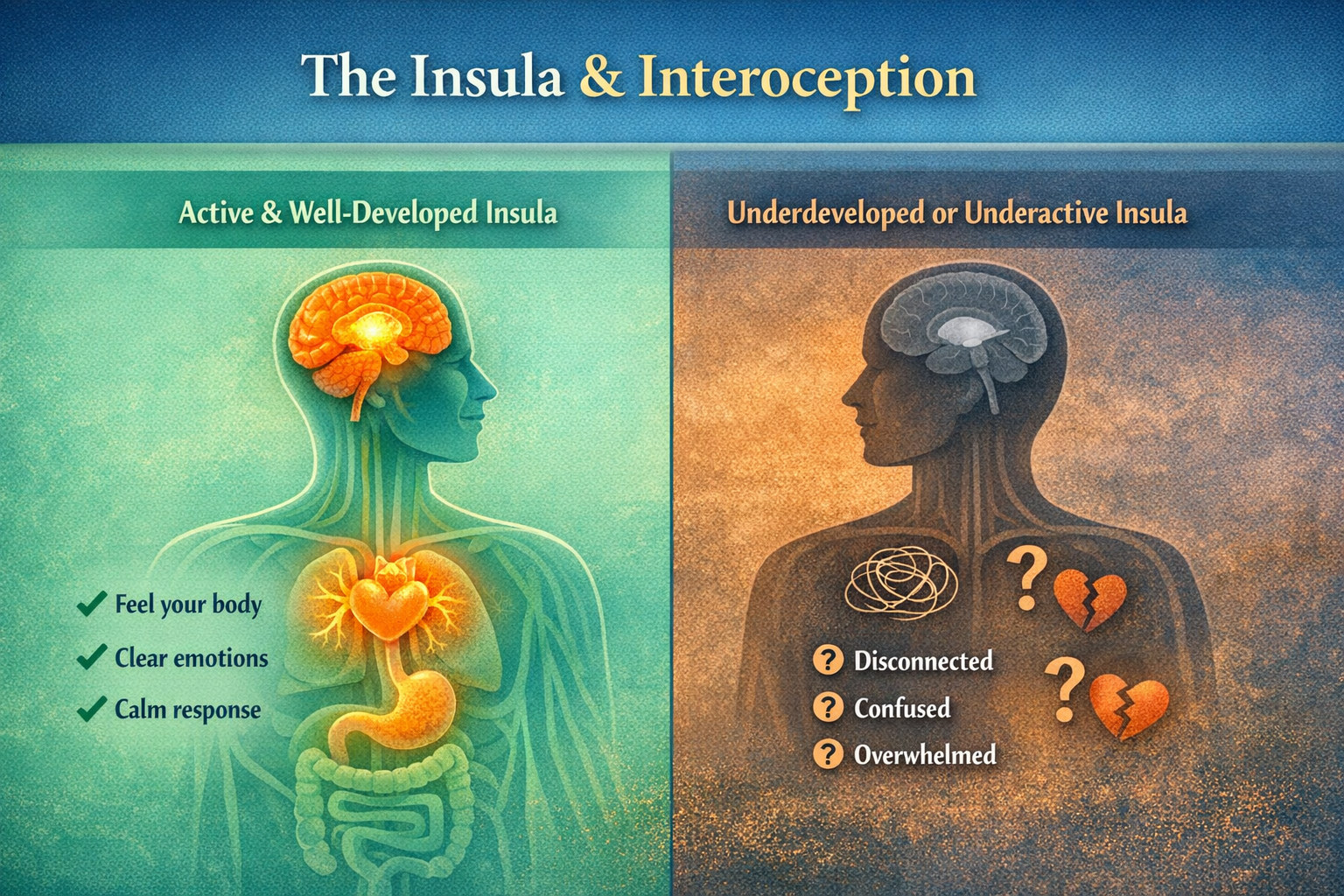
These signals travel to a part of the brain called the insula, which translates them into conscious awareness.
The insula is the hub of:
Emotional awareness
Body awareness
Self-regulation
Decision-making
Intuition
Empathy
When your insula is active and well-developed, you can feel what’s happening inside you and respond with clarity.
When your insula is underactive, it can be harder to know what you feel, what you need, or why your body is reacting the way it is.
The Connection Between Interoception and Mental Health
Research shows a clear pattern.
Lower interoceptive awareness, often linked to a less active insula, is associated with:
Anxiety
Depression
Emotional dysregulation
Eating disorders
Trauma responses
A more developed insula is associated with:
Stronger emotional regulation
Clearer self-awareness
Greater overall functioning
How Meditation and Yoga Support the Brain
So what does this have to do with yoga and meditation?
Practices like yoga and meditation directly support the development of the insula. Over time, they help strengthen interoceptive awareness, allowing you to reconnect with your body.
When you begin to understand what your bodily sensations and emotions are communicating, they become easier to regulate.
And when regulation becomes more accessible, you can stay more connected to yourself, even in moments of stress.
Why This Matters in Therapy
Interoception is foundational to the work I do with clients who are navigating anxiety, depression, and post-traumatic stress.
When we strengthen the connection between the body and the mind, we create space for healing that goes deeper than just talking.
The Most Hopeful Part: The Brain Can Change
The insula is not fixed. It can grow and strengthen over time.
As it does, the bridge between your body and your emotional world begins to rebuild.
And that changes everything.

A Gentle Invitation
If this resonates with you, you don’t have to figure it out on your own. Therapy can be a space to gently reconnect with your body, build awareness, and feel more grounded in your day-to-day life, at your own pace. Reach out here to get started.
About Mallory Tedrick
Mallory Tedrick is a therapist who supports individuals navigating anxiety, depression, and trauma through a holistic, mind-body approach.
Her work integrates traditional therapy with practices like mindfulness, nervous system awareness, and somatic techniques to help clients feel more connected, regulated, and supported in their healing.