
The Ego Isn’t the Enemy, But It Sure Is Loud
A trauma-informed therapy reflection on how the ego shapes thoughts, blocks intuition, and protects us from truth.
Clients often share things like:
“I know they’re not angry at me, but I can’t help feeling that way.” Or, “I feel something deeper, but I can’t trust it.” Another is, “I know I am not crazy, but I feel like I am.”
That shutdown? That’s the ego at work.
The ego is not the villain nor the enemy. But a powerful force shaped by trauma, society, and our instinct to survive.
It’s tempting to believe in healing that we should simply silence the ego or “reframe our thoughts” to dismiss those feelings. However, I don't encourage clients to quiet their ego; instead, I do just the opposite. I encourage curiosity about it, both for myself and my clients. I might pose challenging or seemingly unrelated questions, all aimed at coaxing the ego to express itself. When it begins to speak, we ask: What are you trying to protect me from?
What Is the Ego, Really?
Psychologically, the ego is our sense of self: our identity, our story, our interface with the world. It helps us navigate reality, make decisions, and maintain boundaries.
Spiritually, the ego is the part of us that clings to separation, status, and certainty. It’s the voice that says, “I am this” and “I am not that.” It’s the part that fears dissolving into something bigger.
In the mind-body therapy space, we use the ego as:
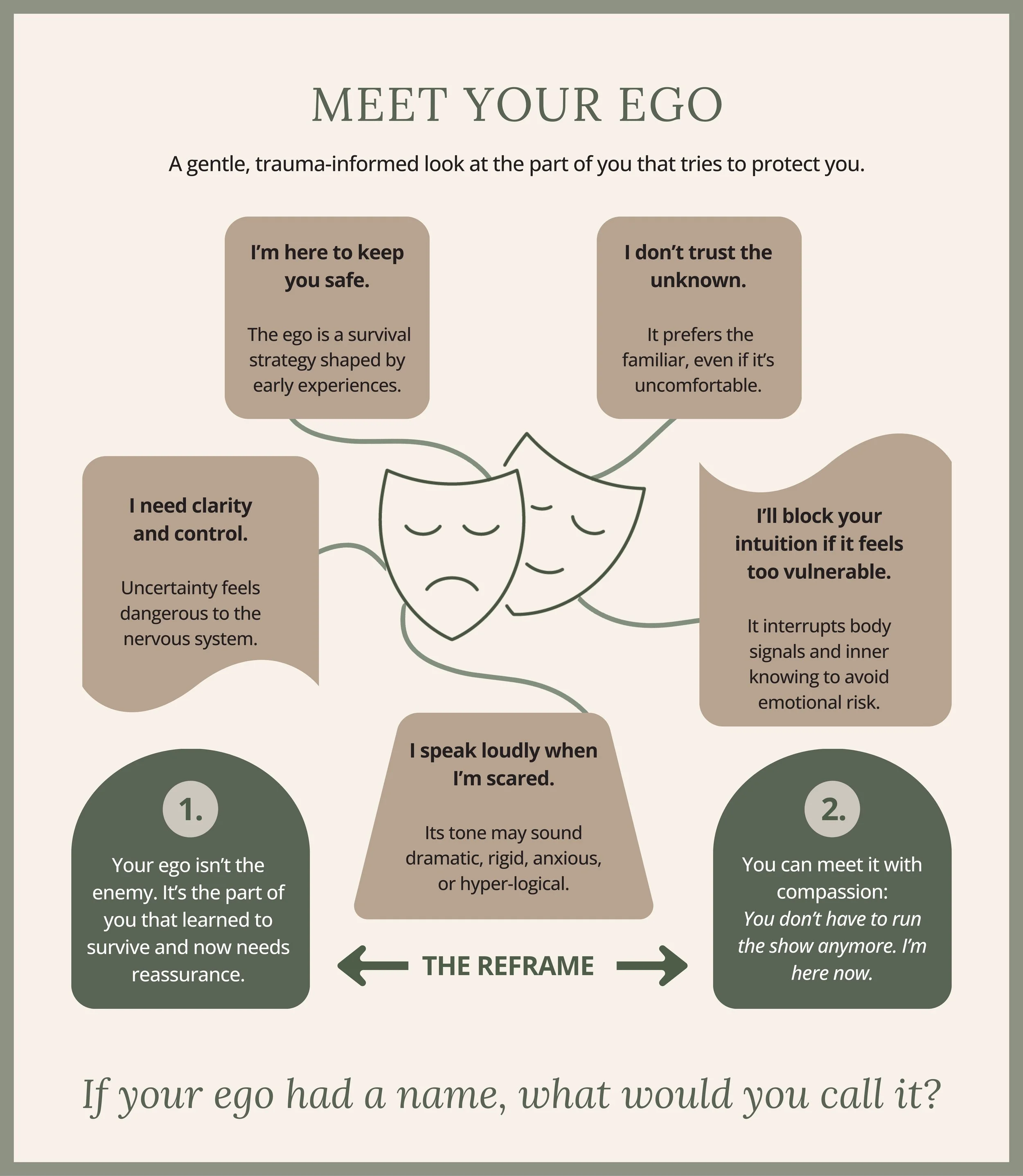
A survival strategy shaped by early experiences
A narrator that tries to make sense of chaos
A gatekeeper that fears change… and even healing
It's not bad. It’s just scared.
Why the Ego Blocks Inner Knowing
Clients often hover near deep insight. They feel something true, something spiritual, intuitive, somatic. But then the ego steps in.
It says:
“That’s not logical.”
“You’re being dramatic.”
“You’re making that up.”
Why? Because the ego was built to protect. And protection often means control. It fears surrender. It fears being wrong. It fears the unknown.
The ego’s job is to keep us safe. But safety, in its language, often means:
Staying small
Staying silent
Staying in the known
How I Work With Ego in Somatic Therapy
I don’t fight the ego. I invite it in.
We ask it things like:
“What do you believe about me?
“What are you afraid will happen if I change?”
“What do you need to feel safe enough to soften?”
Sometimes we meet the ego as “the bitch,” “the devil,” or “the attitude”, not to shame it, but to externalize it. To see it clearly. To understand its tone.
And then we gently ask: Is this voice still serving me?
A Gentle Reframe
The ego isn’t the enemy. It’s the part of you that learned to survive.
It’s loud because it’s scared.
It’s rigid because it’s tired.
It’s blocking your knowing because it doesn’t trust that knowing yet.
But you can build that trust. Slowly. Somatically. Symbolically.
You can meet the ego with compassion and say:
You don’t have to run the show anymore. I’m here now.
Here’s a playful suggestion: If your ego had a name, what would you call it?

When You’re Ready
If you’re sensing that something deeper is speaking beneath the ego’s noise, Mallory Tedrick, LISW, offers a grounded space to explore it. Through trauma-informed, somatic-based therapy, she helps clients reconnect with their intuition and inner safety. When you’re ready, you can begin with a free consultation.